 TM
TM
It was always the desire of the family, even prior generations, to keep their good farm ground in production.
Financial incentives, made possible with agricultural conservation easements, allowed a Kingsburg family to honor that desire for ground they had been farming since 1933.
“It was our family history, we didn’t want to see the land subdivided, that was our mindset,” Jim Moore said.
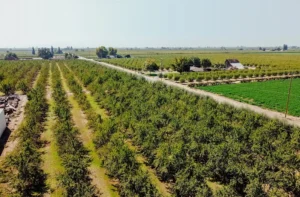
The land Moore’s father farmed was planted in Thompson Seedless grapes. Economic pressure led to a transition to almonds, but that came at a cost. Choices were limited and there was no guarantee that land transactions would keep the ground in farming.
Agricultural easements for their working ground were the solution for the family. Debt could be paid off, the family could keep the land in production and pass it on to the next generation. This type of conservation easement maintains the land in active production. With few exceptions, the owners can continue to farm the ground. The easement is held by Sequoia Riverlands Trust, based in Visalia, which holds conservation easements in Tulare, Fresno, Kern, Kings and San Luis Obispo counties, among others.
Understanding Agricultural Conservation Easements
The California Department of Conservation defines an agricultural easement as a voluntary deed restriction on specific property used for farming. The easement is designed to protect the land by removing development pressure. The deed restrictions remain if the property is sold.
Other types of easements include land for wildlife habitat, open space or resource protection. Working lands easements are used to protect sustainable food, fiber and forest operations.
Agricultural conservation easements are held by land trusts or local governments, which are responsible for ensuring that the terms of the easement are upheld in perpetuity. The easement may be donated to land trusts, sold pending funding sources or a combination of the two.
Nick Reed-Krase, executive director of the Tule Basin Land and Water Conservation Trust, explains that, for the landowner, the benefits of donating or selling the land must outweigh the restrictions placed on the land by the trust.
Timing, planning and location are all vital parts of the transaction.
Reed-Krase said he has seen in recent years significant shifts in landowner perception of trusts and more openness to easement consideration.
“There are business decisions, an opportunity to set aside unproductive land for habitat, keep productive land in production, financial incentives or an outright donation for tax purposes.”
Restrictions on groundwater pumping for irrigation, where no alternative water source is available, can be a reason for seeking an easement.
Reed-Krase said adjacent properties and their uses can make a huge difference in the value of the easement. Tax relief can be a huge impetus to preserving the land for agriculture.
The Easement Process and Financial Considerations
Timing is also a part of the process. If the owner is in a hurry to secure an easement, Reed-Krase said it won’t work as it can take six months to a couple of years to find the funding. Donors must see the conservation value, he said.
Reed-Krase said the process to secure an agricultural easement begins with a land appraisal, which is done by a qualified appraiser. The appraisal will determine the full value of the land with all rights intact. The easement value is derived by subtracting what the land is worth with the restrictions on use.
If funding is being acquired through a grant program, the appraised value and price is subject to the program terms, but the easement terms themselves are certainly negotiated.
Development rights are often the main “focus” in trust negotiations, but there could be other restrictions. Emily Boettger, Sequoia Riverlands Trust, said generally any development or activity that has the potential to inhibit the conservation and agricultural value won’t be allowed. A “building envelope” for an easement can contain future housing on a part of the land or a shop expansion. Agricultural activity, like an apiary, would also be allowed. There could also be a discussion of water rights in some cases, as well as mineral rights and commercial recreation. Much of this would be discussed with the landowner early on to understand their long-term interests for the land and going through the appraisal process to understand the property value with all the rights.
When seeking state funding, there is no bargaining or negotiations on the easement value. Applications are subject to the appraised value. The trust that will hold the easement requests funding knowing the appraised value of the land and will seek match funding, or donations to cover easement endowment or additional costs to fund the easement purchase where necessary.
The process begins with a discussion between the trust and the landowner about goals for the property. Funding is followed by long-term stewardship and monitoring. The application to closing timeline is typically six months to two years.
Financial benefits can include cash compensation for the easement value or a tax benefit if the value is donated. Moore said one of his easements was layered on a Williamson Act contract, further reducing property taxes.
Common Misconceptions and Long-Term Impacts
In a presentation during World Ag Expo, Reed-Krase noted some common misconceptions about easements:
Easements do not prevent the landowner from seeking refinancing or taking out bank loans. Reed-Krase said banks will ask to review the easement terms, but in many cases landowners would still be able to use the land in the easement as collateral for loans.
Easements will not make succession planning for the family more difficult, Reed-Krase confirmed. They can make the process easier as land will not have to be sold to cover estate taxes.
Easement holders, typically trusts, will only monitor what is outlined in the easement terms. The landowner controls the farming operations based on the terms. Leasing is still allowed under easements so long as the lessee is aware of and operating within the terms of the easement.
Easement terms can be highly variable and customized to fit the family needs.
Not all easements are the same. They are tailored based on specific interests of the landowner and the land trust. Rarely are two easements the same.
Finding an endangered species on the land may require some restrictions to ensure protection, but this is more likely on a habitat conservation easement than an agricultural easement.
Easements can be amended. It is not an easy process, Reed-Krase said. The amendments depend on the easement terms, the land trust’s amendment policy and legal due diligence with attorneys to make allowable changes.
Finally, easements are not a good fit if landowners are uncertain about selling the property for development rights in the future, if major changes in the farming operation are anticipated or if the benefits don’t outweigh the restrictions.
Publisher’s Take
The Big Picture: What to do Next
- Financial incentives
Easements can provide cash compensation or significant tax benefits. - Land remains in production
Farming and leasing are generally allowed under easement terms. - Plan ahead
The process can take six months to two years to complete. - Terms are customizable
Building envelopes and certain rights can be negotiated. - Supports succession planning
Easements can help families retain land across generations.

Cecilia Parsons | Associate Editor
Cecilia Parsons has lived in the Central Valley community of Ducor since 1976, covering agriculture for numerous agricultural publications over the years. She has found and nurtured many wonderful and helpful contacts in the ag community, including the UCCE advisors, allowing for news coverage that focuses on the basics of food production.
She is always on the search for new ag topics that can help growers and processors in the San Joaquin Valley improve their bottom line.
In her free time, Cecilia rides her horse, Holly in ranch versatility shows and raises registered Shetland sheep which she exhibits at county and state fairs during the summer.