 TM
TM
They described her as fierce and independent, a farmer who thinks outside the box. They said her journey to agriculture didn’t follow the traditional path, that she does things her own way.
In the International Year of the Woman Farmer, an Oregon woman has claimed the 2026 Top Producer Woman in Agriculture Award.
Amity, Oregon, hazelnut and grass seed farmer Helle Ruddenklau accepted the award at the 2026 Top Producer Summit, Feb. 8 in Nashville, Tennessee.
“I am so very honored to have been selected,” Ruddenklau said.
Helle, from Denmark, and her husband, Bruce, from New Zealand, farm a diverse mixture on 1,100 acres, including hazelnuts, grass seed and rotation crops. Their journey has not been linear and not without its struggles, and it took all of those attributes showered upon Helle at the award ceremony, the fierceness, independence and individuality, for the husband and wife team to make it.
At one point, according to Bruce, he was ready to walk away from the farm. Helle, however, made sure that didn’t happen.
“We stepped into something that we really didn’t know what we were getting into in terms of the problems that we had to encounter and deal with,” Bruce said. “And I remember being ready to walk away from it. It just seemed like it was an insurmountable mountain to climb. But Helle was determined that we could make it work.”
It turns out that the 360 acres they purchased in the early 1990s had an extensive history of chemical-resistant grasses, something they didn’t know until they started farming the ground.
The farm eventually turned to no-till, one of the first Oregon farms to do so, after determining that traditional farming practices weren’t going to cut it.
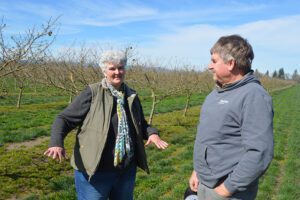
transition their 360-acre home ground to hazelnuts and focus solely on the crop (All photos M. Lies.)
“It was just an ongoing cycle that we weren’t getting ahead,” Bruce said, “so no-till was absolutely key to having a different way of approaching that, to where you could leave those weed seeds on the surface after harvest, let them sprout through the winter, spray them with Roundup in the spring and then no-till in a spring rotation broadleaf crop. And that change was pretty significant in trying to get ahead of those weeds.”
Even with the change in strategy, profitability was still a ways off for Ruddenklau Farms. Again, it was Helle who proved pivotal in keeping the farm going.
Bruce noted that Helle, who holds a master’s degree in crop science from Oregon State University, supported the farm in the early years with income from her work with OSU Extension’s cereals program. Later, she ran a lime buggy for Western Farm Service while pregnant with the couple’s second child.
“No wonder he’s a big boy,” Bruce said. “He was exposed to a lot of calcium.”
Bruce added that what he saw in Helle was typical of what he saw from farm wives throughout his life. His mother and his grandmother invested thousands of hours to ensure his family farm in New Zealand ran smoothly. And Helle’s mom was instrumental in the success of her family farm in Denmark, he said.
“Not only did she drive tractor in the middle of the night, but then she would be feeding a big crew all day long,” Bruce said of Helle’s mom. “That work was Herculean. And I think back to my grandmother and my mother with the input they had on the farm that was really kind of behind the scenes, but it was the stuff that actually made it function.”
Today, Helle “is involved in every major decision of the farm,” Bruce said. She does the books, and, like her mother before her, runs the combine during harvest, as well as performs other farm chores as needed.
The farm branched into hazelnuts in 2017, planting 50 acres of Yamhills. They’ve since doubled that and plan to eventually plant their entire home ground, 360 acres, to the crop.
“We are going to transition the home property to hazelnuts over the next few years, and as that comes into production, then we will eventually give up our rental ground and at some point down the line just focus on hazelnuts,” Helle said.
“I like the industry,” she said. “With all the new hazelnut growers coming in, there is still a lot to be learned about production, and so it is an exciting industry to be in in terms of all the innovation that is happening right now.
“A lot of people are experimenting, trying something new,” she said. “People are learning from each other, and people are lifting each other up. Everybody is willing to talk to everybody else and give advice. It’s just a really, really nice industry to be getting into and learning more about.”
The farm had some struggles early on with hazelnuts, losing about a third of their trees in year three to vole damage after the pest moved into their orchard from a neighboring grass seed field after harvest.
“And we had to try to figure out whether we were going to just take all the trees out and say, ‘forget about it,’ because that also pretty much coincided with the low prices that were hitting the industry,” Helle said. “And so, it was like, ‘Why are we doing this?’ But we went through and cut back the damaged trees to basically ground level and let them re-sucker. And then we picked the best sucker, trained that as the new stem, and cut everything else back. So, those trees are behind the others, but they are coming along.”
The couple likes the yields and the early maturity they get with Yamhill, and although the trees have lost their resistance to Eastern Filbert Blight (EFB), they plan to stay with the variety.
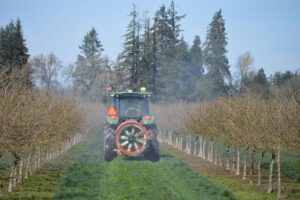
Strong Ag Advocate
Among the attributes that likely drew the awards panel to select Helle is her advocacy for agriculture. Included in an extensive list of farm organizations for which she volunteers are Oregon Women for Agriculture, an organization she has served for the better part of 40 years, and Oregon Ag in the Classroom, for which she serves on the board. She hosts schoolchildren to the farm each year as part of Oregon Aglink’s Adopt a Farmer program. She serves on the OSU College of Agricultural Sciences’ E.R. Jackman Board, sits on the Extension Advisory Board and on the Yamhill County Extension Budget Committee. She and Bruce also host a teacher each year to the farm as part of Summer Ag Institute. And she is a commissioner on the Oregon Tall Fescue Commission.
Helle is also active on social media, updating her followers on the farm’s activities and explaining why the farm does what it does.
“Being a farmer in my mind is about the most wonderful job you can have,” she said, “and the fact that there are fewer and fewer people involved in agriculture makes it important to try and educate people about what we do.
“Roughly 1% to 1.5% of the population is actively farming, yet we are impacted by what the rest of society thinks of us through the laws, the voters and through the purchasing decisions at the grocery store or big-box stores. So, it is important for us to get the word out that what we’re doing is sustainable and responsible and that we follow the law, take care of the environment and that we care about the land that we are given temporary stewardship over.
“And so, if people don’t hear directly from us, they have no way of knowing that,” she said.
Helle said she was surprised when she opened an email informing her that she had won the Top Producer Woman in Agriculture Award for 2026.
Given her credentials, perhaps she shouldn’t have been.